Monday, 18 March 2013

Crossing the Big Void for Risers


I grew up in southern Quebec where the countryside is full of trees: maple forests, birch...thick stands are everywhere. It rains a lot there and it's humid so things root and quickly grow skyward. Rural roads are fringed with trees. Homes have trees around them. Even the parks in downtown Montreal are full of trees. Small streams and creeks are often canopied by broad branches. Trees are always around you. They are company and make the world seem smaller, more intimate. Trees create boundary lines and delineated spaces within a larger space.

When I drive south of Lethbridge into Montana I always feel uneasy. No matter where I look it is just stark open space. Treeless. Like a big void. There are few boundary lines, especially in the Winter time when it all seems so colourless and lifeless and the grey land blends with the muted sky, and a horizon doesn't even seem to exist. When I'm out there I feel that I might just disappear; that the space will somehow inhale me. I look for pronghorn antelope or coyote just to see if things can survive without being swallowed up by all the nothingness.

I feel relieved when I approach the town of Great Falls, Montana because I see structure: homes, large buildings, and of course trees. I pass through and drive further south along the meandering Missouri river edged by comforting cottonwoods and mountains in the distance, and feel even more confident. I have made the crossing intact.

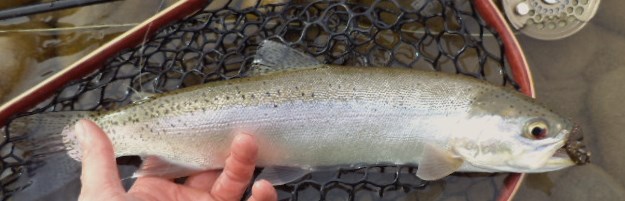
This past weekend I drove south of Lethbridge to get an early start on the angling season. I braved the crossing and the cold as I knew trout would probably be rising on the other side. And they were. When the wind took a break and the water calmed, trout surfaced for midges. And I caught a few. I caught trout in mid March when Winter refused to give way to Spring. I caught them on minute size 20 dry flies on a river over two football fields wide. I caught them after braving the big void.

midge fly

walking the plank to an island


midge hatch
if they don't rise for small dries, I shoot them

 
flat water side channel


Saturday, 9 March 2013

Whitefish On Ice


rocky mountain whitefish

I walked a section of the Crowsnest river today. I haven't been on it since the Fall. I casted nymphs. Picked up a couple of Whitefish on Zebra midges. The river is lower than I have ever seen it.  All the local rivers are. There were a lot of anglers out. Water temperature mid day in the sun, 38F. I looked for risers when the wind died down but no luck. The stream side snow banks had some little black stoneflies crawling on them. The trout will probably be up looking at midges in about three weeks time: April.


Sunday, 3 March 2013

River Life: Beginnings and Endings

 
I went to a local tailwater river yesterday to see if there were any midges hatching. It was fairly mild for early March but the wind was howling, 60 Km plus and I therefore didn't expect much. I planned to wait until supper time to see if it would calm down and whether the tiny bugs would collect in the shallows. The wind did abate at 5 pm but there were few midges around.

I spent the afternoon walking the river and taking it all in as I haven't fished in awhile. I mainly threw a streamer with dumbbell eyes and let it sink and swing, and then slowly stripped it in. I picked up two Rainbows this way. I also nymphed a bit but had no luck with this strategy. A more skilled bottom dredger probably would have done better. A small trout did rise to the "plop" of my pink strike indicator. It always amazes me when this happens, especially in the winter time. I should have tossed a beetle at him.

The water temperature at river's edge in the sun was 40F and then later in the day when cloudy 38F...not bad for this time of year. Spring might come early...might! I saw many deer, an eagle, waterfowl and feathers. I spotted what looked like a dead Pelican. Several years ago on the same river I found a dead Coyote after run-off.

A river is a place of beginnings and endings.

Endings:

pelican
 
coyote

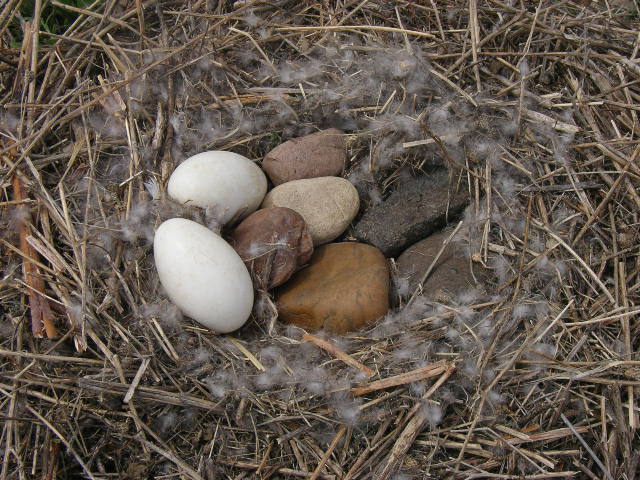
In the Spring Geese nest along the river.

Beginnings:

goose eggs ringed in down

goose eggs along with some fakes


Monday, 18 February 2013

Brown Trout from Past Seasons

fall tailwater brown, caught on beetle 
 
The first stream I ever fly fished had predominately Brown and Rainbow trout in it. The Rainbows were stocked. The Browns were also stocked yearly but they were more likely to survive or "hold over" and some even reproduced. That is what I fished for: wild trout. They were the prized catch. Some actually grew very large considering the size of the stream and that it was Eastern acidic water, and somewhat nutrient poor. Landing a few good sized Browns made my season.

Most of the Western rivers I now fish are dominated by Rainbows but it is always nice to land a few good Browns. They still make my season. They are special.

All of the fish below were spotted and caught on the surface with small stuff except two... they were enticed by a hopper.


tailwater brown, caught on pmd
 
spring creek brown, caught on hopper
 
tailwater side channel brown
 
oldman river brown, caught by joe f.
oldman river brown, caught by author

Monday, 4 February 2013

Baja Rooster Fishing: Tough on the Feet

It took me a couple of seasons to figure out what footwear to use on Baja beaches. It was two painful seasons. After a long winter my soft Canadian feet screamed out when sand got in my shoes. It migrated from the ankles down to the toes and chafed them severely. If you are only fishing for an hour or two or are fairly stationary no problem, you can get by with almost any type of footwear: water sport sandals or crocs with neoprene socks or barefoot. The same goes if you are riding on a four wheeler (quad) all day, as most beach anglers chasing rooster fish do. However, if you are out all day walking and covering great distances for a week or more, then good footwear is a must. You need shoes that help keep the sand out. Of course, you'll never keep it all out. Some sand always gets in when you are hiking up and down dunes, sprinting after a fish, or charging into the surf to get within casting range. It is all a matter of how much gets in. If it is too much your feet really suffer.

On my second season in Baja I tried out a rubberised skin tight water shoe, something a scuba diver would wear. After hiking all day I discovered they were jamming and lifting the nails off of my big toes. The next day I changed to a different shoe but the damage was done. I completely lost one nail when running on the beach and a day or so later the other one lifted and flapped up and down when I entered the water. The exposed flesh was gory looking: think watermelon red and soft. Everything stuck to it: socks, sand, small shells, sea weed fibers, dirt, etc. It was an infection waiting to happen! And it stung. After a couple of days fishing this way and having a wandering Mexican dog track me down and lick one of my toes, I decided it was time to head to a small government medical clinic in the nearby village of La Ribera.

There was a female Doctor on duty and a nurse. Both were friendly. I later found out the nurse was the Doctor's mother. Something like that could only happen in a small town. Somehow we communicated even with my poor Spanish and their limited English and my toe situation was quite obvious. In about 30 minutes they cleaned my damaged toes thoroughly by repeated rinsing and cleaning grit with Q-tips, applying antiseptic, wrapping them in gauze and then taping them up securely. I was provided with extra gauze and tape for future maintenance. I also was given over a one week supply of antibiotics and an anti-inflammatory. I couldn't thank them enough. Following I was informed that the fee was 130 pesos, about 10 dollars US. I couldn't believe it. This is the side of Mexico never reported in the media.

Due to the care I received I was able to carry on with my fishing trip. I re-wrapped my big toes every morning with white gauze and tape and this is what they looked like at the end of day...


The next season I purchased bonefish sneakers from Cabelas and they were great. I have used them every year since. They are comfortable and keep a lot of the sand out. With 12 days of continuous fishing my feet still take a beating but with the flats sneakers it is manageable. Simms and Orvis now make a similar product.

Sunday, 13 January 2013

More Baja Scenes and Colour

Here are some more pictures taken while Rooster fishing in Baja: some Mexican village scenes; some colour; and Rooster fish.
 
why I wear flats shoes
 
rooster fish
 
 
dorsal fin


santiago, baja
santiago, baja


Friday, 4 January 2013

Baja Colours and Scenes

Here are some more pictures of Southern Baja scenes while beach fly fishing the Sea of Cortez in 2009, 2010, and 2012.


santiago,baja


ribera beach road
 
The picture below is of a Jack. In Mexico they are appropriately named, Toro as they fight like a bull. 


baja jack


sand dunes and la trinidad mountains
la trinidad range, coastal baja